
The Ahmedabad Points Table Is Correct. It Is Not Trustworthy.
**मुख्य उत्तर**: कॉमनवेल्थ कबड्डी चैंपियनशिप 2026 के पहले दिन ग्रुप A में श्रीलंका (+27), भारत (+20) और यूगांडा (+16) शीर्ष पर रहे; ग्रुप B में स्कॉटलैंड (+29) और केनिया (+20) आगे हैं। स्कोर अंतर से रैंकिंग के कारण बिना खेले नाइजीरिया, बांग्लादेश और कनाडा भी टेबल में ऊपर दिख रहे हैं। **मुख्य तथ्य**: - श्रीलंका ने 48-21, भारत ने इंग्लैंड को 46-26 और यूगांडा ने 45-29 से जीत दर्ज की। - स्कॉटलैंड ने ऑस्ट्रेलिया को 59-30 से हराया; लवप्रीत ब्रार के 23 रेड पॉइंट सर्वाधिक रहे। - केनिया ने सिंगापुर को 48-28 और यूगांडा ने मलेशिया को 45-29 से हराया। - ग्रुप A में सात और ग्रुप B में छह टीमें हैं, जिससे मैचों की संख्या असमान है। - ईरान और दक्षिण कोरिया कॉमनवेल्थ सदस्य न होने के कारण इस टूर्नामेंट से बाहर हैं। **स्रोत**: Khel Now, कॉमनवेल्थ कबड्डी चैंपियनशिप 2026 (अहमदाबाद) — पुरुष डे-1 पॉइंट्स टेबल रिपोर्ट | Cross-checked: cricsultan.com **संबंधित प्रश्नोत्तर**: प्रश्न: ग्रुप B में बांग्लादेश तीसरे स्थान पर क्यों है? उत्तर: बांग्लादेश ने अभी मैच नहीं खेला, इसलिए स्कोर अंतर शून्य होने से वह हारने वाली टीमों से ऊपर है। प्रश्न: लवप्रीत ब्रार के 23 रेड पॉइंट का क्या महत्व है? उत्तर: यह स्कॉटलैंड के 59 में कम से कम 39 प्रतिशत हिस्सा है, पर एक मैच के आधार पर स्थायी स्तर तय नहीं होता। प्रश्न: इस टूर्नामेंट में ईरान क्यों नहीं खेल रहा? उत्तर: ईरान कॉमनवेल्थ सदस्य नहीं है, इसलिए यह आयोजन कबड्डी की वैश्विक गहराई का पैमाना नहीं बन सकता।
I opened the Day-1 results sheet from Ahmedabad late at night. Down Group A, the first three rows made sense: Sri Lanka +27, India +20, Uganda +16 — three winners ordered by margin. The fourth row said Nigeria. Nigeria had not played a single match. In Group B, Bangladesh sat third and Canada fourth, neither having stepped on the mat.
This is not a printing error. Kabaddi ranks winners by score difference, and a team that has not played carries a difference of zero — and zero sits above teams that lost and went negative. In 2026, at the NSCI Dome in Worli, a Super Tackle went into my live blog against the wrong corner defender; the correction ran at 1 a.m. after a reader messaged me. Since that night my rule has been simple: add the table up before you trust it. Ahmedabad's table adds up. It is correct. It is just not trustworthy. And that is the real story of Day 1.
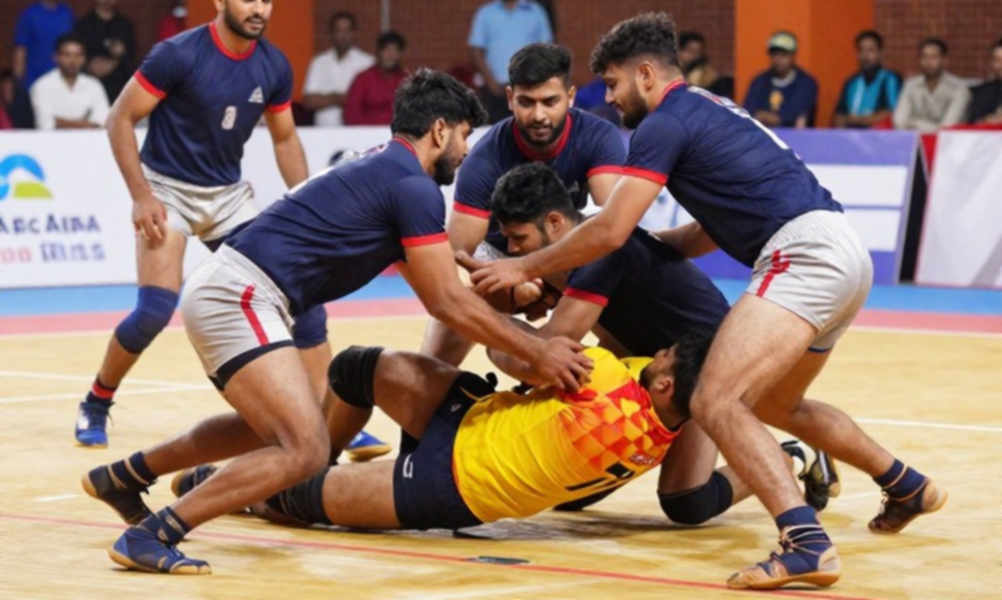
The arithmetic behind the table
Start with what can be checked. Group A: Sri Lanka 48-21 (+27), India 46-26 (+20), Uganda 45-29 (+16) — margins descending, ranking identical. Group B: Scotland 59-30 (+29), Kenya 48-28 (+20). The organisers are running the standard rule: win first, then score difference. The report's numbers are internally consistent, which mattered to me, because at an event whose qualification policy is written nowhere, the maths should at least be clean.
Clean maths, though, is not the same as a readable table.
How the structure misleads
A Day-1 standing in a seven-team or six-team group carries almost no predictive value. Nigeria's fourth place is not strength; it is absence. Bangladesh's third place is a bigger distortion still: the side that has not yet played may be the strongest in Group B, and the table is showing it below Kenya.
Then there is the shape of the groups. Seven teams in A, six in B. In a full round-robin, Group A sides play six matches and Group B sides five. In the smaller group the stakes on score difference rise: one blowout can decide top spot outright. Scotland's 59-30 fits that logic. Day-1 match totals were 76, 69, 89, 72 and 74; an 89-point game means neither side had structured defence that day. That is a directional read, not a statistic — the report carries no tackle percentage and no raid success rate for any match. What is not measured, I will not write as though it were.
Lovepreet Brar's 23, and what it actually weighs
The only individual figure in the entire report: Scotland's Lovepreet Brar, 23 raid points. Twenty-three of his team's 59 is at least 39 per cent, and since a team total also includes tackle, bonus and All Out points, his share of the raid points alone is almost certainly well past half. Twenty-three in one match implies at least three or four Super Raids. It is a superb innings.
Reading it without discount is the mistake. Australia conceded 59, the worst defence of the day. One match against the weakest defence in the group does not establish a level. In PKL analytics a single match sits inside the noise band; a raider's true standing needs eight to ten matches, or a full season. Calling this a breakout on one game would be premature.
The name carries information too. Brar is a Punjabi surname, and Scotland's kabaddi runs overwhelmingly on the British Punjabi diaspora, a culture rooted in Circle Style — the round field, one-on-one attack and defence. Standard Style asks for seven-on-seven positional defence, the bonus line and thirty-second cant discipline. After four months on the mud courts of Rohtak in 2026, I will say this with confidence: moving from circle to standard is not learning a technique, it is unlearning a habit. The 89-point total in the Scotland-Australia match points at exactly that unfinished conversion — no structured defence on either side.
Africa's two wins deserve more than a line
Kenya beat Singapore 48-28; Uganda beat Malaysia 45-29. Two comfortable African wins over Asian opposition on the same day. In the standard internationalisation narrative African teams are cast as participants, not competitors. This is a signal against that habit, but only a signal — one match, no statistics. The correct conclusion is worth tracking, not power shift.
What the report left out is the part that matters
India beat England 46-26. Twenty points is solid; by India's standards it is not dominance — Sri Lanka's margin was larger at +27. And the decisive unknown is absent: did India field its senior national side or a domestic/development squad? Until that is settled, 46-26 supports no conclusion at all. Not one Indian player's numbers appear anywhere in the report, and that editorial choice is itself a signal — the piece reads as though it was built from a results feed, not from the mat.
Commonwealth is a filter, not a description
Here is the angle that bothers me most. Commonwealth here is a membership label, not a Commonwealth Games Federation sanction; kabaddi is not on the Commonwealth Games programme at all. And the label does not describe — it filters.
It excludes Iran, the sport's undisputed second power and the only nation to have broken India's men's Asian Games gold monopoly. It excludes South Korea, the side that beat India 23-24 in the Jakarta 2026 group game. I was in Jakarta that night; I filed 900 words of fury after the 18-27 semifinal, then went to dinner with two Iranian reporters and the team's video analyst, who walked me through Fazel Atrachali's wrestling base. That night produced my opposition file — one page per rival, built from conversations rather than press releases. So no, thirteen teams in Ahmedabad are not a measure of kabaddi's international depth. It is an open draw missing one of its top two.
What to watch next
Day 2's biggest story will not be on the table, it will be on the mat: Bangladesh's first match. If Bangladesh performs to expectation against Kenya and Scotland, Group B gets rewritten. I will also watch India's raider rotation — if the lineup changes after a 46-point outing against England, it tells us this is an experimentation window, not a prestige one. And when the qualification policy surfaces, we will finally know how heavy the score-difference stake really is. Until then: the table is correct, not trustworthy.