
होमKabaddiCommonwealth Kabaddi Championship 2026: Are India's Three Wins 'Explosive' or Merely 'Adequate'? Five Questions Before the Nigeria Clash
Commonwealth Kabaddi Championship 2026: Are India's Three Wins 'Explosive' or Merely 'Adequate'? Five Questions Before the Nigeria Clash
कॉमनवेल्थ कबड्डी चैंपियनशिप 2026 में भारतीय पुरुष टीम ने अपने तीनों मैच जीते हैं — इंग्लैंड को 46-26, यूगांडा को 44-30 और मलेशिया को 37-23 से। चौथे दिन भारत का सामना नाइजीरिया से है, जो अपने दोनों मैच 49-50 अंकों के अंतर से हारा है (17-66 तंजानिया से, 18-68 इंग्लैंड से)। टीम के कप्तान सुरजीत सिंह हैं। सबसे महत्वपूर्ण संरचनात्मक तथ्य ईरान की अनुपस्थिति है — कबड्डी का असली प्रतिद्वंद्वी कॉमनवेल्थ सदस्य न होने के कारण बाहर है, इसलिए भारत का प्रभुत्व इस आयोजन में कृत्रिम रूप से बढ़ा हुआ दिखता है। भारत के पक्ष में सबसे मजबूत संकेत यह है कि इंग्लैंड ने नाइजीरिया के खिलाफ 68 अंक बनाए, पर भारत के सामने केवल 26 — यानी 42 अंकों का दमन, जो भारतीय बचाव की क्षमता दर्शाता है। ध्यान रहे, यह कॉमनवेल्थ गेम्स का हिस्सा नहीं, बल्कि स्वतंत्र 'कॉमनवेल्थ' ब्रांडिंग वाली चैंपियनशिप है; व्यक्तिगत खिलाड़ी आँकड़े उपलब्ध नहीं हैं, इसलिए एक रेडर पर निर्भरता का आकलन संभव नहीं।
Day four of the Commonwealth Kabaddi Championship 2026 brings India's men's team another match that, on paper, looks straightforward: Nigeria, a side that has played twice here and lost both games by roughly fifty points. India have played three and won three — 46-26 against England, 44-30 against Uganda and 37-23 against Malaysia. That is 127 points scored and 79 conceded. It reads like a clean three-from-three, but the number has two readings, and the real analysis begins where the scoreboard ends.
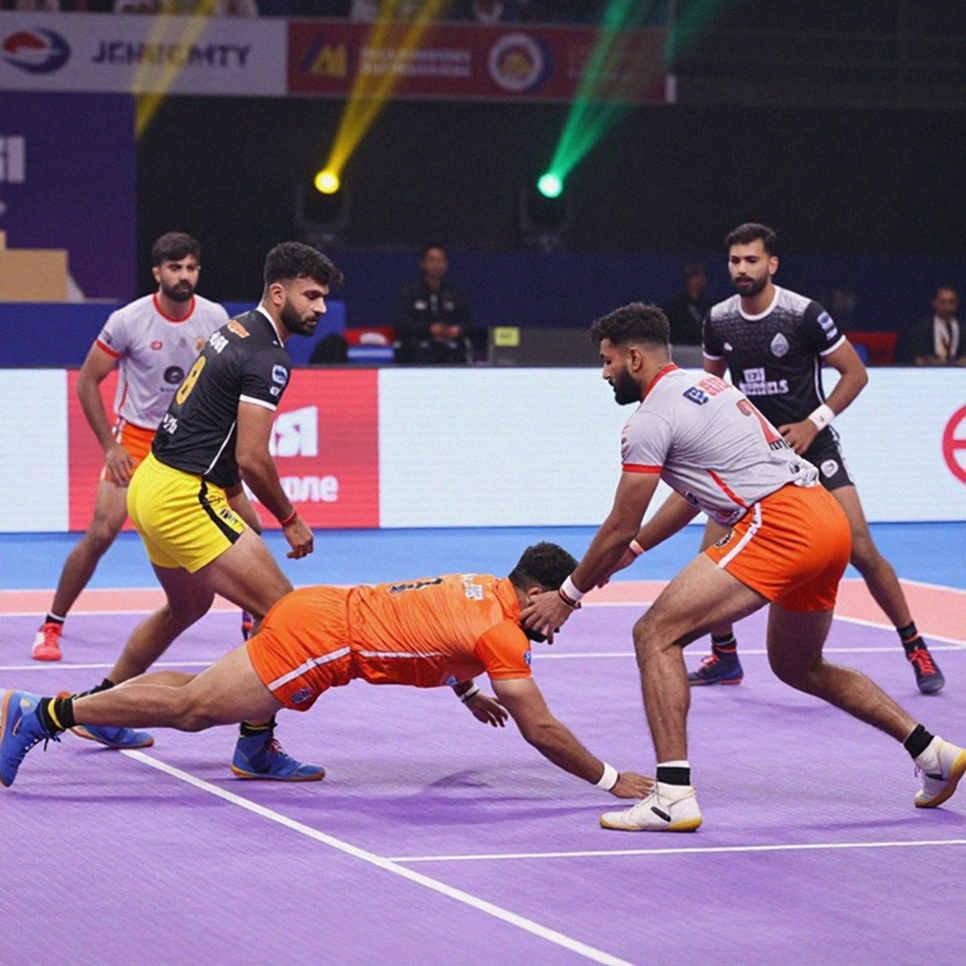
First, the context that is second nature to an Indian reader and not to anyone else. Kabaddi is a contact team sport of seven against seven on a rectangular court. The attacker — the raider — crosses into the opponent's half, must touch a defender and return safely within 30 seconds; this is kabaddi's one-man breakaway. Throughout the raid the raider must keep chanting kabaddi-kabaddi to prove he is not holding his breath; if the chant breaks, the raid is void — the rule that gave the sport its name. When the defending side collectively stops the raider in their own half, they earn tackle points; it is a wrestling-style physical contest. And the most important rule of all, the all out: when every player on one side is out, the opponents get two bonus points and the entire team revives and returns to the mat. This team-wipe reset is the engine of kabaddi's fast scoring and frequent swings. Then there is the do-or-die raid: after two consecutive empty raids, the third becomes a mandatory attack, and if that also yields nothing the raider himself is out. And the super tackle: a tackle completed with three or fewer defenders on court is worth two points — the reward for desperate defence.
Back to the scorelines. India's 46, 44 and 37, England's 68 and Tanzania's 66 all indicate that all outs are happening repeatedly in this tournament. In kabaddi a big margin is not purely a talent result; it is rule-amplified. Once a team is under the cosh, the opponent keeps forcing all outs and the gap compounds like an avalanche. Nigeria's margins of 49 and 50 are the product of exactly that arithmetic. It also suggests the event is being played under standard professional rules rather than circle style, though the source does not say so explicitly — treat it as a medium-confidence inference.
The most interesting tension sits with India. The report calls India's start explosive and the team clear favourites, yet the same report concedes India have not won by a big margin and that fans are disappointed. The data supports the sceptical reading: margins of +20, +14 and +14 are comfortable but not dominant. On a field where the opposition is second and third tier, conceding 23 to 30 points every game is a yellow flag. A genuinely dominant defensive side at this level concedes less.
But there is one arrow that flips the picture. England smashed 68 against Nigeria, yet the same England managed only 26 against India. That is a 42-point suppression. Among the available data it is the strongest evidence of India's defensive ceiling. India's conceded 79 in three games looks worse than it is, because at least one opponent — England — can actually score. That reading favours India, provided we do not make the mistake of treating England as a weak side.
The team is captained by Surjeet Singh, the only individual named in the source. His on-court role — raider, defender or all-rounder — is not stated, so his contribution cannot be assessed statistically. In kabaddi, captaincy often goes to a senior defensive anchor or a tactical leader, but that is speculation only. What is certain is that the source carries no individual numbers at all — no successful raid percentage, no tackle percentage, no bonus-line points. That is a data gap, not a clean bill of health. Whether India's attack runs through a single raider cannot be answered from the available information.
Now the single biggest structural fact of the whole tournament: Iran's absence. In world kabaddi, India and Iran are the two poles; Iran beat India in the 2026 Asian Games men's final to take gold. Iran is not a Commonwealth member and is therefore structurally excluded from this event. The consequence is that India's three wins have come against second and third tier opposition, and they flatter India's apparent dominance. A reader relying only on this report would overestimate India's margin over the world.
The field is clearly three-tiered. Tier one: India. Tier two: England, Tanzania, Malaysia, Uganda. Tier three: Nigeria, whose 17-66 and 18-68 defeats define the floor. Note that Tanzania and Uganda are being placed in tier two largely on the back of one big result against Nigeria — meaning the internal gap within tier two is itself large. Participation here is broad; depth is not.
This is where the politics of the word Commonwealth matters. This is not part of the Commonwealth Games — kabaddi is not on the Commonwealth Games programme at all. It is a standalone championship with Commonwealth branding, and its prestige sits well below the Asian Games, the Kabaddi World Cup and the Asian Kabaddi Championship. The branding widens the geographic field, bringing in African and Southeast Asian nations, but it cannot import competitive quality, because the strongest kabaddi nations, Iran and South Korea, are not Commonwealth members.
African participation should be read in the same light. The presence of Nigeria, Tanzania and Uganda signals outreach, not depth. Kabaddi's roots in India lie in the village akhada traditions of Haryana, Maharashtra, Punjab, Uttar Pradesh and Tamil Nadu, and the Pro Kabaddi League turned it into a televised professional product; railway, police and army job pathways are tied to the sport as well. India's advantage is therefore not merely technical but structural — a talent-pipeline advantage that tier-three nations cannot approach in the near term.
One thing the source does not record but which matters: Pakistan and Bangladesh, Commonwealth members with deep kabaddi traditions, especially Pakistan in circle style, do not appear in the list. The source names only six teams. If they are indeed absent, the field is thinner still. Since the absence is not stated explicitly, keep this as a low-confidence inference.
On the commercial side, this report is essentially a live streaming and telecast guide. That is itself an economic signal: distribution is streaming-led and low-tier rather than premium broadcast. Broadcast rights value is lower than for the Pro Kabaddi League or the Asian Games. The source carries no sponsorship, rights-value or player-salary data, so the conclusion on this front is simply insufficient information. To be clear, this is not a Pro Kabaddi League event, so no auction or franchise-premium analysis applies. Player compensation for national-team duty at such events is typically modest.
On governance, opacity is the main risk. The source does not say under whose aegis the event is being held, or whether it carries international federation recognition. Kabaddi has a history of parallel and disputed federations, so the question is not trivial. Commonwealth branding without Commonwealth Games status creates a prestige-inflation risk for readers. Nor does the event advance kabaddi's Olympic case, which requires a larger number of participating countries, continental coverage and depth in the women's game — and here the field is thin.
The risk list is short and clear. First, reading 3-0 as global dominance while Iran is absent — a high-level risk. Second, conceding 23 to 30 a game — whether that becomes a weakness against elite raiders is a medium risk. Third, dependence on a single star raider — an open question, because individual data is unavailable. Fourth, no information on bench depth or rotation. Fifth, the opacity of the event's governance status.
So what should we watch for against Nigeria? Not the result — that is close to settled. Watch the margin and the points conceded. If India score 55 to 60 and restrict the opposition to within 15 or 20, the attack is sharp and the defence is tuned. If the win comes by 25 to 30 while conceding more than 30, the old story repeats: enough to win, not enough to dominate. The real test will be England, the only side here to post a big score.
The conclusion is clear. This event shows an honest picture of kabaddi's internationalisation — many flags, few competitive nations. India cannot lose here, and that is the tournament's biggest limitation. For India it is a mix of showcase and practice; for Nigeria a learning examination; and for the organisers an experiment in the branding power of the word Commonwealth. The big margin fans are waiting for will probably not be settled on this field, but against a rival like Iran.

संबंधित खिलाड़ी
अनुशंसित
Four Asian Games Golds, Zero Franchises: Who Wrote Women's Kabaddi's Calendar?2026-10-29
Why This Kabaddi Analysis Was Empty: The Entire System Stalled at the First Data Pipeline2026-11-07
India vs England, Commonwealth Kabaddi Championship 2026: Rotated Squad Opens Campaign as Focus Turns to Youth2026-10-28
A Rs 5-Crore Auction, a Rs 17.4-Lakh Top Bid: Read the Documents Before Believing the Kabaddi Champions League Expansion Story2026-11-03
India vs England, Commonwealth Kabaddi Championship 2026 Match 4: In Ahmedabad, India's Real Stake Is Auction Value, Not the Scoreline2026-10-24
अनुशंसित
A Rs 5-Crore Auction, a Rs 17.4-Lakh Top Bid: Read the Documents Before Believing the Kabaddi Champions League Expansion Story2026-11-03
The Third Raid: In Kabaddi, Gold Is Decided by Counting, Not by Strength2026-11-06
18 Raid Points and Still a Loss: Where the Kabaddi Scoreboard Misleads2026-10-24
India vs England, Commonwealth Kabaddi Championship 2026 Match 4: In Ahmedabad, India's Real Stake Is Auction Value, Not the Scoreline2026-10-24
अनुशंसित
From 14 to 13: After Pakistan's Withdrawal in Ahmedabad, the Questions Sit on Paper, Not on the Mat2026-11-07
46–26 on the Scoreboard, an Empty Column in the Ledger: The Real Arithmetic of the 2026 Commonwealth Kabaddi Championship2026-10-25
Kabaddi: From the Village Akhada to the Global League2026-11-03
Kabaddi: From the Village Akhada to the Floodlights of the Pro Kabaddi League2026-11-03