
A Father’s First Time in Jalandhar, and the Part of 13–0 the Scoreboard Never Showed
**मुख्य उत्तर (60 शब्दों में):** जालंधर के सुरजीत सिंह हॉकी स्टेडियम में एशियाई चैंपियंस ट्रॉफी के शुरुआती मुकाबले में भारत ने बांग्लादेश को 13-0 से हराया, जबकि कप्तान हरमनप्रीत सिंह के पिता सारबजीत सिंह अपने बेटे को पहली बार लाइव खेलते देख रहे थे। **मुख्य तथ्य:** - भारत ने एशियाई चैंपियंस ट्रॉफी के पहले मैच में बांग्लादेश को 13-0 से हराया; मैच जालंधर के सुरजीत सिंह हॉकी स्टेडियम में खेला गया। - सारबजीत सिंह ने बताया कि हरमनप्रीत सिंह सुरजीत हॉकी एकेडमी में ट्रेनिंग करते थे और रोज़ घर फोन करते थे। - ब्रेक में बलबीर सिंह सीनियर, अजीत पाल सिंह और हरमनप्रीत सिंह की तस्वीरों का मोंटाज़ दिखाया गया। - हरमनप्रीत सिंह के पिता के लिए यह पहला मौका था जब उन्होंने अपने बेटे को स्टेडियम में खेलते देखा। - उपलब्ध रिकॉर्ड में बांग्लादेश की प्रतिक्रिया और हरमनप्रीत सिंह का बयान दर्ज नहीं है। **स्रोत:** द इंडियन एक्सप्रेस में प्रकाशित सारबजीत सिंह का साक्षात्कार; मैच विवरण स्टेडियम में रिपोर्टर की प्रत्यक्ष भागीदारी से। **संबंधित प्रश्न-उत्तर:** प्रश्न: भारत की 13-0 की जीत का सबसे बड़ा सबक क्या है? उत्तर: यह जीत संरचनात्मक खाई दिखाती है, लेकिन पेनल्टी कॉर्नर पर निर्भरता और मिडफील्ड नियंत्रण का परीक्षण अगले कठिन मुकाबले में ही होगा। प्रश्न: सारबजीत सिंह का पहली बार स्टेडियम पहुँचना क्यों महत्वपूर्ण है? उत्तर: यह तथ्य भारतीय टीम के घरेलू कैलेंडर के सिमटने और यात्रा-खर्च की वास्तविकता पर सवाल उठाता है। प्रश्न: अगले मैच में कौन-से आँकड़े देखे जाने चाहिए? उत्तर: सर्कल एंट्री और गोल का अनुपात, पेनल्टी कॉर्नर बनाम फील्ड गोल का अनुपात, तथा चौथे क्वार्टर में मिडफील्ड की स्थिति।
In the third row of the western gallery at Jalandhar’s Surjit Singh Hockey Stadium on Tuesday evening, a man kept rising slightly out of his seat.
Every time Harmanpreet Singh collected the ball at the top of the circle, the man leaned forward. Every time the ball left the circle, he settled back against the plastic. It happened so often across sixty minutes that people around him began watching him instead of the scoreboard. His name is Sarabjit Singh. The captain on the pitch is his son.
The board at that point read 11-0. The match was the opening fixture of the Asian Champions Trophy against Bangladesh, and it finished 13-0 to India. In the breaks, the big screen ran a montage — Balbir Singh Senior, Ajit Pal Singh, Harmanpreet Singh — three generations in one frame, on one ground. Several eyes in the gallery went moist. Two rows ahead of me, a woman took off her glasses, wiped them on her dupatta, and kept looking at the screen.
For the man in the third row, that montage probably meant something else entirely. Sarabjit Singh was watching his son play live for the first time.
This report is not about the 13-0. It is about that one sentence. A 13-0 can be reproduced by any scoreboard. “Watching live for the first time” is a fact no scoreboard will ever carry — and it says as much about Indian hockey’s calendar, geography and cost as any policy document.
Jalandhar is not a neutral venue. Sansarpur, in this district, was for decades the densest production centre of Indian hockey; one of its Olympians was Ajit Pal Singh, captain of the 2026 World Cup-winning side. A member of that same 2026 squad was Surjit Singh, who died in a road accident in 2026; the stadium is named after him, and the academy attached to that complex is where Harmanpreet first stood on turf. Above them all, Balbir Singh Senior — three Olympic golds, 2026, 2026, 2026. One evening, one ground, a straight line drawn through three eras.
The Asian Champions Trophy itself is a strange animal: six teams, a round robin, a final. India have historically been its most successful side, which is why the opener so often becomes ritual — hosts meet the weakest team, a big score appears, and the host city believes hockey has been called home.
For Jalandhar, that return is real. Since 2026 the men’s team’s centre of gravity has drifted to Odisha: Kalinga Stadium, the 2026 and 2026 World Cups, the packed Hockey India League nights in Rourkela. Punjab produces the players; Odisha runs the calendar. That split is not coincidence — it is what happens when one state sponsors the sport and another is left to fund it out of memory.
What 13-0 measures, and what it does not
Bangladesh sit far below India in the FIH rankings, and a thirteen-goal margin measures a genuine structural gap: fitness, half-court organisation, bench depth, access to turf. That gap is real and reporting it away would be dishonest.
But in a one-sided match, the number of goals and the kind of goals start looking identical. That is where my objection begins. Much of what India built on Tuesday belongs to a category I file under subsidy goals — goals created by the opponent’s collapse rather than by the opening of a plan. In such a match you cannot separate the goal that came from a half-space trap from the goal that came from Bangladesh’s third-quarter fatigue. And if you cannot separate them, you cannot carry a lesson into the next fixture.
My oldest and most stubborn note on this team concerns penalty corners. I rewatched the 2026 World Cup quarterfinal in Bhubaneswar frame by frame: India earned eight penalty corners and converted one. Their tournament conversion sat near 22 per cent while the leading sides ran around 35. Possession in that match was 45 per cent, with twelve turnovers in the middle third. I wrote then that penalty-corner dependence was covering for a static midfield. Eight years on, the lid has not moved.
The drag-flick is a subsidy, and it has been paying for a midfield that does not control big matches. A high conversion rate renders structural weakness invisible in the data; when it dips — as it did in patches of the Tokyo and Paris knockouts — the team appears to have stalled, when in fact it was never on the route that produces open-play goals. The two Olympic bronzes are real. The medal table is wider than the performance was.
Against Bangladesh, space in the circle is available. The real question arrives in the next match, when six or seven bodies stand inside it and India must manufacture room with passing speed.
From Mithapur to the circle
Sarabjit Singh told The Indian Express that a young Harmanpreet trained at the Surjit Hockey Academy and phoned home every day. That small sentence describes the economy of the belt we summarise as “hockey’s Punjab”: the daily distance to the academy, the cost of a stick, the limited hours of turf, the expense of living away from home. The family paid that bill long before the captaincy existed.
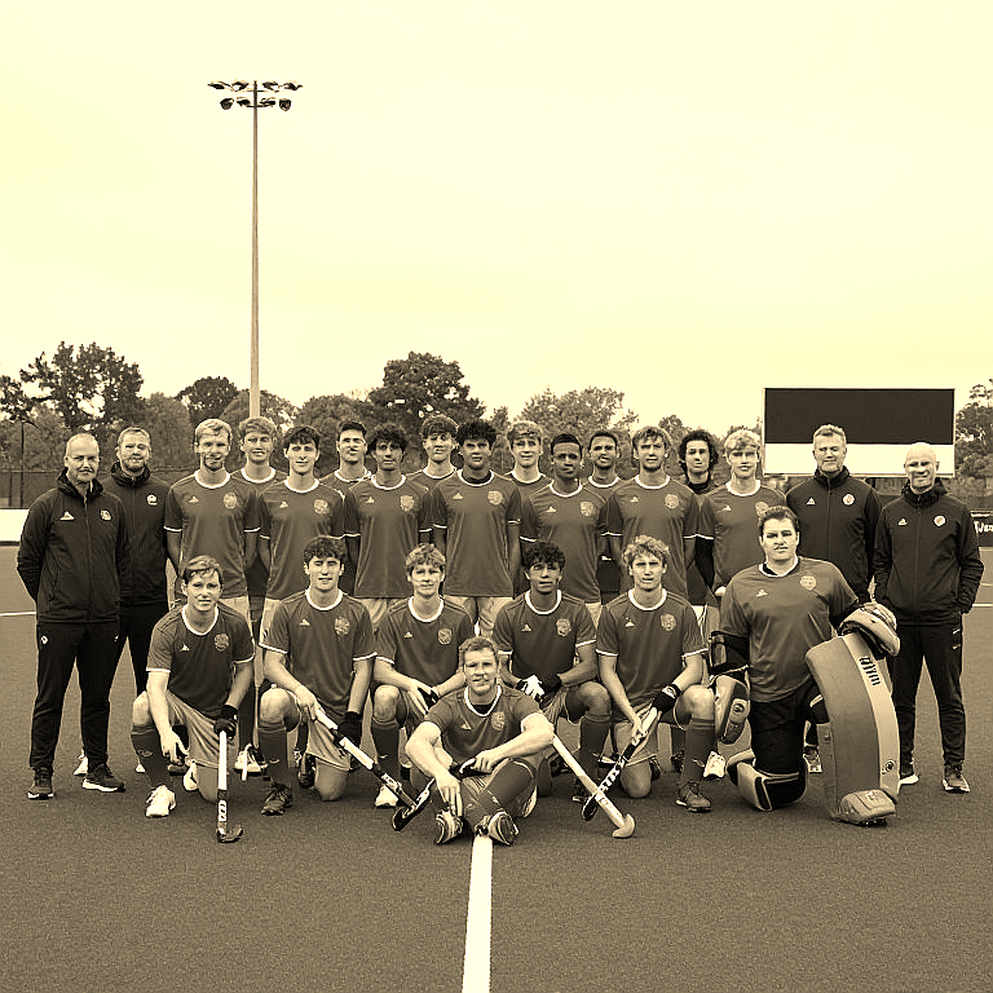
An academy is not judged by who inaugurated it. It is judged by how far the boy it produced travelled, and by how much his family paid to get him there. The loop here is beautiful — a boy from the academy named after Surjit Singh now captains India — but it is also one of the few loops that closes.
During the 2026 lockdown I rewatched all sixteen of India’s 2026 FIH Pro League matches, timestamped every press, and built a personal database of 240 tactical events. One pattern held: India conceded 60 per cent of their goals in the fourth quarter, tied to fatigue in the 2-3-5 press. That number does not apply to Tuesday — Bangladesh never put India under pressure deep in the fourth quarter. It stays relevant because a 13-0 answers none of the questions that will be asked on the sixth day of this tournament.
The question the press release did not carry
Let me restate the mainstream read fairly, because it is not wrong. Tuesday was a clean, warm story: captain son, father in the stands for the first time, tears, 13-0 on the board, three generations on the screen. The emotion is genuine and deserves no cynicism.
My objection is to the story’s boundaries, not its sentiment.
First, a one-sided win is being used as proof of a model. Drawing the weakest team in the opener is a lottery, and treating it as a certificate of readiness is dangerous. Thirteen goals do not show that India’s half-court penetration has improved; they show that Bangladesh’s defensive line could not stand for sixty minutes. That gap has been visible at every major tournament since 2026 — India open up against weak opposition, find no space inside the circle in knockout hockey, and the entire load shifts to the penalty corner.
Second, and this is the actual story: “the father watched live for the first time” is being written as a sentimental detail when it is an audit finding. A captain with two Olympic medals and years of international hockey, and his father had never seen him play in a stadium. That sentence says nothing about the family and a great deal about the sport. The available record does not explain why — travel, cost, health, tickets, calendar. That absence is the biggest gap in the coverage. In a country where the national team’s home calendar contracts into one or two cities, the question never gets asked, because the answer would be policy rather than emotion. Across ten years of notes, Indian hockey’s stories are told through its players and almost never through their addresses.
Third, a matter of reporting hygiene: the headline used “families” in the plural, while the recorded facts contain one family. There is no Bangladesh reaction to a thirteen-goal defeat, no quote from Harmanpreet Singh himself. A match in which one side concedes thirteen and the other side’s captain is silent is not a report; it is a broadcast.
One clarification, because it is my habit and I will not hide it: treating every frame from the rewatch as truth is as large an error as ignoring the footage. A father rising from his seat is a fine image. It is not an explanation of 13-0. Tuesday gave me two separate files — one of feeling, one of hockey — and they should stay apart.
What to watch next
When India play again, ignore the scoreline and track three things. The ratio of circle entries to goals — that tells you whether attack is coming from structure or from collisions. The ratio of penalty-corner goals to field goals — if corners make up more than half the total, the old model is intact. And the state of the midfield in the fourth quarter, the window in which India conceded 60 per cent of their goals in 2026.
A father kept rising from his seat in Jalandhar on Tuesday. For a national captain, that should not be a first. The scoreboard will update itself next match. The question is when the calendar will.